Canadian History for Citizenship Test
Prepare for your Canadian Citizenship Practice Test with our free, accurate, and up-to-date practice tests. All questions are based on the official Discover Canada guide, helping you study the exact topics covered on the real test — including Canadian history, government, laws, symbols, and more. Track your progress, get instant feedback, and build confidence to pass on your first attempt.

Report a question

What to Expect on the Official Canadian Citizenship Test
Number of Questions
20
Correct Answers to Pass
15
Passing Score
75%
Length of Test
45 min
Canadian History for Citizenship Test – Study Guide & Practice Questions
Canadian Citizenship Practice Test 2026
What Is Canadian History in the Citizenship Test?
Canadian history is one of the most important topics in the Canadian Citizenship Test. The test measures how well applicants understand the historical events, people, and milestones that shaped Canada into the country it is today.
Learning Canadian history helps new citizens understand Canada’s values, democratic traditions, and national identity.
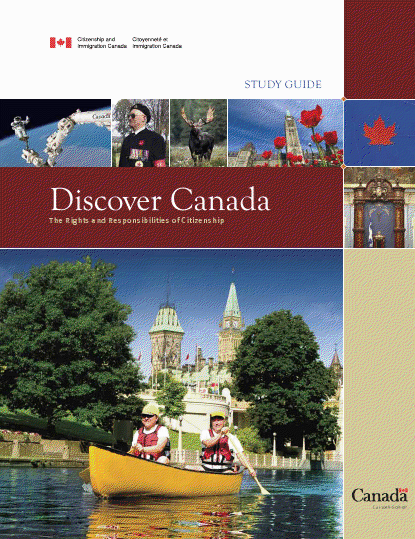
The questions are based entirely on the official study guide:
Discover Canada: The Rights and Responsibilities of Citizenship
This guide explains Canada’s history from early Indigenous civilizations to modern Canada.
Canadian Citizenship Test Practice Questions
Canadian History Topics Covered in the Citizenship Test
The citizenship test includes questions from several important historical areas. Understanding these topics will help you prepare effectively.
Indigenous Peoples of Canada
Long before European settlers arrived, Canada was home to many Indigenous nations with rich cultures and traditions.
The three main groups of Indigenous peoples in Canada are:
• First Nations
• Inuit
• Métis
These communities lived across the land for thousands of years and developed strong cultural traditions, languages, and governance systems.
Indigenous peoples played a key role in Canada’s early history, including helping European explorers survive and navigate the land.
Understanding Indigenous history is essential because it is a foundational part of Canada’s identity and reconciliation efforts today.
Canada Citizenship Test Questions
Early European Exploration
European exploration began in the late 1400s and early 1500s.
Some of the earliest explorers who arrived in Canada include:
• John Cabot (1497) – One of the first Europeans to explore the Atlantic coast
• Jacques Cartier (1534) – Explored the St. Lawrence River and claimed land for France
• Samuel de Champlain (1608) – Founded Quebec City and helped establish New France
During this period, French and British colonies began to grow in North America.
These early settlements laid the foundation for Canada’s future political and cultural development.
Free Canadian Citizenship Practice Test
New France and British Rule
For many years, much of Canada was controlled by France and known as New France.
The French established settlements along the St. Lawrence River and developed the fur trade with Indigenous peoples.
However, Britain and France fought several wars for control of North America.
A major turning point occurred in 1759 during the Battle of the Plains of Abraham, when British forces defeated the French in Quebec.
This led to the Treaty of Paris (1763), where France officially gave most of its North American territories to Britain.
From that point forward, Britain became the dominant colonial power in Canada.
Canadian Citizenship Exam Practice
The Path to Confederation
Confederation was one of the most important moments in Canadian history.
On July 1, 1867, the Dominion of Canada was officially created.
The first four provinces were:
• Ontario
• Quebec
• Nova Scotia
• New Brunswick
This event established Canada as a self-governing country within the British Empire.
Several leaders known as the Fathers of Confederation helped create the new nation.
One of the most famous was Sir John A. Macdonald, who became Canada’s first Prime Minister.
Over time, more provinces and territories joined the Confederation to form modern Canada.
Canada Citizenship Test Preparation
Expansion of Canada
After Confederation, Canada continued to grow westward and northward.
Key milestones include:
• Manitoba joined Canada in 1870
• British Columbia joined in 1871
• Prince Edward Island joined in 1873
• Alberta and Saskatchewan became provinces in 1905
• Newfoundland and Labrador joined Canada in 1949
The construction of the Canadian Pacific Railway played a major role in connecting the country from east to west.
It helped strengthen national unity and supported economic development.
Discover Canada Practice Questions
Canada in the World Wars
Canada played an important role in both World War I and World War II.
World War I (1914–1918)
More than 600,000 Canadians served in the war.
One of the most important battles was the Battle of Vimy Ridge in 1917, where Canadian forces achieved a major victory.
This event is often seen as a defining moment for Canadian national identity.
World War II (1939–1945)
During the Second World War, over one million Canadians served in the military.
Canada contributed soldiers, equipment, ships, and aircraft to support Allied forces.
The war helped establish Canada as an important international partner and strengthened the country’s global reputation.
Canadian Citizenship Mock Test
Modern Canada
After World War II, Canada experienced major social, economic, and political changes.
Important developments include:
• Expansion of immigration policies
• Growth of multiculturalism
• Development of universal healthcare
• Adoption of the Canadian flag in 1965
• Patriation of the Constitution in 1982
Canada also officially adopted the Canadian Charter of Rights and Freedoms in 1982, protecting the fundamental rights of citizens.
Today, Canada is known worldwide for its democratic institutions, diversity, and commitment to human rights.
Online Canadian Citizenship Test Practice
Frequently Asked Questions
Is Canadian history important for the citizenship test?
Yes. Canadian history is one of the major sections of the citizenship test and many questions come from this topic.
What historical events should I study?
Important topics include Confederation, early exploration, Indigenous history, World Wars, and modern Canadian developments.
Are history questions difficult?
They are manageable if you study the official guide and practice regularly.
How many history questions are on the test?
There is no fixed number, but several questions typically relate to Canadian history.
What is the best way to learn Canadian history for the test?
Reading the official study guide and taking practice tests is the most effective preparation method.
Online Canadian Citizenship Test Practice
Sample Canadian Citizenship Test Question
Here is an example of a history question that may appear on the citizenship test.
Question:
Who was the first Prime Minister of Canada?
A. William Lyon Mackenzie King
B. Sir John A. Macdonald
C. Lester B. Pearson
D. Pierre Trudeau
Correct Answer:
B – Sir John A. Macdonald
He served as Canada’s first Prime Minister and played a key role in Confederation.
Online Canadian Citizenship Test Practice
How to Study Canadian History for the Citizenship Test
Preparing effectively can greatly improve your chances of passing the citizenship test.
1. Study the Official Guide
The official resource for the exam is Discover Canada: The Rights and Responsibilities of Citizenship.
All test questions are based on this guide.
2. Take Practice Tests
Practice tests help you:
• Understand the test format
• Identify weak areas
• Improve memory retention
• Build confidence before the real test
You can practice here:
https://citizenshiptest.online/canadian-citizenship-practice-test/
3. Focus on Important Historical Events
Many questions focus on key milestones such as:
• Indigenous history
• European exploration
• Confederation
• World Wars
• Development of modern Canada
Understanding these topics will help you answer most history-related questions.
4. Review Key Dates and People
The citizenship test often includes questions about important figures and events.
Examples include:
• Sir John A. Macdonald
• Confederation in 1867
• Battle of Vimy Ridge
• Adoption of the Canadian flag
• The Charter of Rights and Freedoms
Learning these facts will improve your exam performance.
Online Canadian Citizenship Test Practice
Why Canadian History Matters
Studying Canadian history is not just about passing a test.
It helps you understand:
• How Canada developed as a nation
• The struggles and achievements of its people
• The values of democracy and freedom
• The importance of cultural diversity
Learning this history helps new citizens feel more connected to Canada and its traditions.
Canada Citizenship Test Preparation
Key Topics Covered in the Citizenship Test
The Canadian Citizenship Test covers several important subjects.
Canadian History
Learn about major historical events including Confederation, early exploration, and modern developments.
Canadian Government
Understand the structure of Parliament, the roles of the Prime Minister and Governor General, and how elections work.
Rights and Responsibilities
Citizens have rights such as freedom of expression and responsibilities such as obeying the law and voting.
Geography
You should know Canada’s provinces, territories, major regions, and natural resources.
Canadian Symbols
Important national symbols include the maple leaf, national anthem, and Canadian flag.
Economy & Modern Canada
Learn about Canada’s modern economy, industries, and role in the world.
Discover Canada – The Rights and Responsibilities of Citizenship
Discover Canada: The Rights and Responsibilities of Citizenship is used by newcomers to study for the citizenship test. It also contains information about the history of Canada, how our government works, symbols of Canada and its regions.