Canadian Government for Citizenship Test
Prepare for your Canadian Citizenship Practice Test with our free, accurate, and up-to-date practice tests. All questions are based on the official Discover Canada guide, helping you study the exact topics covered on the real test — including Canadian history, government, laws, symbols, and more. Track your progress, get instant feedback, and build confidence to pass on your first attempt.
Report a question
What to Expect on the Official Canadian Citizenship Test
Number of Questions
20
Correct Answers to Pass
15
Passing Score
75%
Length of Test
45 min
Canadian Government for Citizenship Test – System, Parliament & Elections
Canadian Citizenship Practice Test 2026
What Is the Canadian Government System?
Understanding how the Canadian government works is an important part of the Canadian Citizenship Test. Applicants must demonstrate knowledge of Canada’s political system, democratic institutions, and how citizens participate in government.
Canada is a constitutional monarchy and a parliamentary democracy. This means the country recognizes a monarch as the head of state while elected officials run the government through Parliament.
Questions about government structure, elections, and political leadership come directly from the official study guide:
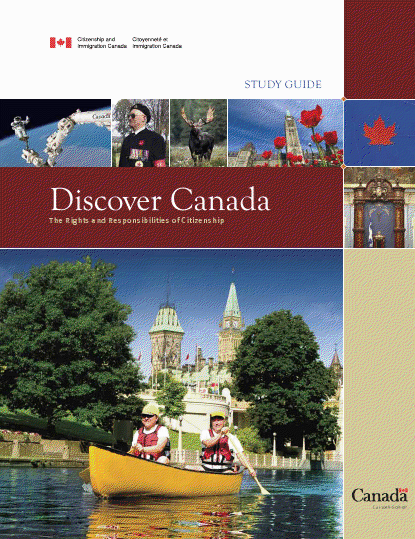
Discover Canada: The Rights and Responsibilities of Citizenship
Learning these concepts will help you better understand how Canada is governed.
Canadian Citizenship Test Practice Questions
Key Government Topics on the Citizenship Test
Citizenship test questions often focus on the following government-related areas:
• Structure of the Canadian government
• The role of the monarch and Governor General
• Parliament and its two chambers
• The Prime Minister and Cabinet
• Federal, provincial, and municipal governments
• Elections and voting rights
Understanding these topics will help you answer government-related questions correctly.
Canada Citizenship Test Questions
Canada as a Constitutional Monarchy
Canada is a constitutional monarchy, meaning the country has a monarch as the official head of state but operates under a constitution that limits political power.
The monarch of Canada is currently:
King Charles III
The monarch’s role is mostly ceremonial and symbolic.
In Canada, the monarch is represented by the Governor General, who carries out duties such as:
• Signing laws passed by Parliament
• Opening Parliament sessions
• Representing Canada at official events
• Appointing the Prime Minister
The Governor General performs these duties based on the advice of the elected government.
Free Canadian Citizenship Practice Test
Canada’s Parliamentary Democracy
Canada’s political system is also a parliamentary democracy, meaning citizens elect representatives who make laws and govern the country.
Eligible citizens vote during federal elections to choose members of Parliament who represent their communities.
These elected officials are called Members of Parliament (MPs).
The political party that wins the most seats in Parliament usually forms the government.
The leader of that party becomes the Prime Minister.
Canadian Citizenship Exam Practice
The Structure of Parliament
Canada’s federal Parliament has three main parts:
The Monarch (represented by the Governor General)
The House of Commons
The Senate
Together, these institutions create and pass federal laws.
Canadian Citizenship Exam Practice
The House of Commons
The House of Commons is the main legislative body where elected representatives debate and vote on laws.
Members of Parliament represent electoral districts known as ridings.
Their responsibilities include:
• Debating national issues
• Proposing and voting on laws
• Representing the interests of their constituents
• Holding the government accountable
Federal elections determine who sits in the House of Commons.
Canadian Citizenship Exam Practice
The Senate
The Senate is the upper chamber of Parliament.
Senators are appointed rather than elected and review laws passed by the House of Commons.
Their role is to carefully examine legislation and ensure it serves the interests of all Canadians.
Senators represent different regions of Canada to maintain balance across the country.
Canadian Citizenship Exam Practice
The Prime Minister and Cabinet
The Prime Minister is the head of government in Canada.
The Prime Minister leads the federal government and is responsible for:
• Setting national policies
• Leading the Cabinet
• Representing Canada internationally
• Managing government departments
The Prime Minister selects ministers to form the Cabinet.
Cabinet ministers oversee major government departments such as:
• Finance
• Health
• Immigration
• National Defence
• Foreign Affairs
Together, the Prime Minister and Cabinet make key decisions about national policies and government programs.
Canadian Citizenship Exam Practice
Levels of Government in Canada
Canada has three levels of government, each responsible for different areas.
Federal Government
The federal government is responsible for national matters such as:
• National defence
• Immigration and citizenship
• Currency and banking
• International trade
• Criminal law
Federal laws apply across the entire country.
Canadian Citizenship Exam Practice
Provincial and Territorial Governments
Canada has 10 provinces and 3 territories, each with its own government.
Provincial and territorial governments handle areas such as:
• Education
• Health care
• Natural resources
• Property and civil rights
Each province elects a legislative assembly led by a Premier.
Canadian Citizenship Exam Practice
Municipal Governments
Municipal governments manage local services within cities and towns.
They are responsible for services such as:
• Public transportation
• Fire services
• Local roads
• Parks and recreation
• Waste management
Municipal leaders are usually called mayors.
Canadian Citizenship Exam Practice
Elections in Canada
Canada holds regular elections to allow citizens to choose their representatives.
Federal elections are generally held every four years.
Canadian citizens aged 18 and older have the right to vote.
Voting is a key democratic responsibility.
During elections:
• Citizens vote for candidates in their local riding
• The candidate with the most votes becomes the Member of Parliament
• The party with the most MPs typically forms the government
Voting helps ensure that government decisions reflect the will of the people.
Canadian Citizenship Exam Practice
Why Voting Is Important
Voting is both a right and a responsibility of Canadian citizens.
Participating in elections allows citizens to:
• Choose their representatives
• Influence national policies
• Strengthen democracy
• Hold leaders accountable
High voter participation is an important part of Canada’s democratic system.
Discover Canada Practice Questions
Sample Canadian Citizenship Test Question
Here is an example of a government-related question that may appear on the citizenship test.
Question:
Who is the head of government in Canada?
A. The Governor General
B. The Prime Minister
C. The Monarch
D. The Speaker of the House
Correct Answer:
B – The Prime Minister
The Prime Minister leads the federal government and manages national policies.
Canadian Citizenship Mock Test
How to Study Canadian Government for the Citizenship Test
Preparing properly will help you answer government-related questions confidently.
1. Study the Official Guide
All citizenship test questions come from the official study guide:
Discover Canada: The Rights and Responsibilities of Citizenship
Carefully review the sections about government and democracy.
2. Learn the Structure of Parliament
Make sure you understand:
• The role of the House of Commons
• The role of the Senate
• The responsibilities of the Prime Minister
These topics frequently appear on the test.
3. Understand Levels of Government
Citizenship test questions often ask about the responsibilities of federal, provincial, and municipal governments.
Learning these differences is important.
4. Practice with Sample Tests
Practice tests simulate the real exam format and help reinforce your knowledge.
You can take a free practice test here:
https://citizenshiptest.online/canadian-citizenship-practice-test/

Canadian Citizenship Mock Test
Why Learning Canadian Government Matters
Understanding Canada’s government system helps new citizens participate fully in Canadian democracy.
It allows citizens to:
• Vote responsibly in elections
• Understand how laws are created
• Know their rights and responsibilities
• Participate in civic life
Learning about Canada’s political system strengthens democratic participation and civic engagement.
Online Canadian Citizenship Test Practice
Frequently Asked Questions
What type of government does Canada have?
Canada is a constitutional monarchy and a parliamentary democracy.
Who is the head of state in Canada?
The monarch, currently King Charles III, is the head of state.
Who is the head of government?
The Prime Minister is the head of government.
How many houses are in the Canadian Parliament?
There are two chambers: the House of Commons and the Senate.
At what age can Canadians vote?
Canadian citizens can vote at age 18 or older.
Canada Citizenship Test Preparation
Key Topics Covered in the Citizenship Test
The Canadian Citizenship Test covers several important subjects.
Canadian History
Learn about major historical events including Confederation, early exploration, and modern developments.
Canadian Government
Understand the structure of Parliament, the roles of the Prime Minister and Governor General, and how elections work.
Rights and Responsibilities
Citizens have rights such as freedom of expression and responsibilities such as obeying the law and voting.
Geography
You should know Canada’s provinces, territories, major regions, and natural resources.
Canadian Symbols
Important national symbols include the maple leaf, national anthem, and Canadian flag.
Economy & Modern Canada
Learn about Canada’s modern economy, industries, and role in the world.
Discover Canada – The Rights and Responsibilities of Citizenship
Discover Canada: The Rights and Responsibilities of Citizenship is used by newcomers to study for the citizenship test. It also contains information about the history of Canada, how our government works, symbols of Canada and its regions.